Menu
Date Published: April 13, 2023 (Updated October 20, 2026)
Table of contents :
If a low credit score is standing between you and the funds you need, you're not alone. Ontario recorded 51,637 consumer insolvency filings in 2024, up 17.8% on the year before (CAIRP). iCash accepts applications from residents with bad credit, and approval is based on your current income, not just your credit history!
Licensed in Ontario (Licence #4733142)
Fully online, no branch visits
Interac e-Transfer® in 2 Minutes
24/7 Applications
256-Bit SSL Encryption
Key Takeaway

Bad credit doesn't rule you out in Ontario. iCash looks at your current income, not just your credit history, so eligible residents can borrow $100 to $1,500 and get funds by Interac e-Transfer in as fast as 2 minutes.
A bad credit loan is a short-term option for residents who don't qualify for financing through a traditional bank, usually because of a low or limited credit history. Rather than screening applicants primarily by credit score, lenders offering this type of loan typically look at whether the applicant has steady, verifiable monthly income.
This means residents with poor or limited credit can often still access short-term funding based on their current financial situation rather than their credit history alone. Approved amounts generally range up to $1,500, often without needing a co-signer, collateral, or extensive paperwork.
Not every lender treats a low score the same way, so it pays to compare before you apply. Banks and credit unions weigh your credit file heavily, while online payday loan lenders put more weight on your income, your bank account activity, and whether the payment fits your budget. That difference is why two lenders can review the same credit report and reach two different decisions.
Payday loans in Canada are also regulated province by province, so the maximum fee, the cooling-off period and the longest available loan term are all set locally rather than nationally. In Ontario, that framework is the Payday Loans Act, 2008.
For full information on payday loan regulations in Ontario, see our Ontario payday loans page. For a broader look at your options across the country, see our bad credit loans in Canada guide.
The average credit score across province is 686 (Borrowell, 2026), above the national average of 679, though scores vary widely by city, from 658 in Hamilton to 714 in Markham.
The provincial consumer insolvency rate was 4.4 per 1,000 adults in 2024 (OSB Canada), above the national average of 4.2. The pressure is uneven across the province: Sudbury (5.8) and Barrie (5.4) sit well above the provincial rate, while Toronto (3.4) sits below it. Toronto readers can see our bad credit loans in Toronto page.
iCash is licensed in every province where we operate across Canada, and we don't use your score as the deciding factor. With 91,986 loans approved to Ontario residents in 2025, our approvals are based on your current ability to repay, not on where you've been financially in the past. See what borrowers say in our iCash reviews.
Credit scores drop for reasons that have little to do with financial responsibility. Some of the most common include:
Rent that leaves no buffer. In Toronto, 47.9% of households rent (Statistics Canada, 2021 Census), so a missed payment during the pandemic or a stretch of high rent can leave a mark that lingers on a credit file
Job loss or reduced hours in cities where unemployment has climbed above 8%, such as London, Kitchener and Windsor (Statistics Canada)
Medical expenses or a family emergency that drained savings faster than expected
Carrying high-interest debt on a card at 19.99% and only being able to pay the minimum each month
Being new to Canada with no Canadian credit history built up yet
A credit file shows where you've been, and it says nothing about the debt you're managing well today. iCash looks at where you are today, which is why your current income carries more weight than a single missed payment years ago. None of these situations make someone a financial risk forever, and none of them reflect poor character or bad decision-making.
Residents with a low score usually have a handful of borrowing options, and each one treats bad credit differently. It's worth comparing all of your options before you apply anywhere:
Option | Typical amount | What to expect with bad credit |
Bank or credit union personal loan | $2,000+ | Lowest rates, but most financial institutions decline scores under 620 and the application can take several days |
Credit card cash advance | Your available limit | No new approval needed if you already hold the card, though interest starts the day you withdraw the cash |
Subprime personal loans | 1,500-15,000 | Approval is possible with a low score, but a variable interest rate of 25%-46% APR, monthly fees and multi-year terms are common |
Payday loan from a licensed lender like iCash | 100-1,500 | Income-based approval, a flat fee instead of compounding interest, funds by e-Transfer in minutes |
Borrowing from family, or an employer pay advance | Varies | Free or low-cost, but the cash isn't always available on the day you need it |
If most of what you owe is high-interest card debt, a debt consolidation loan can work out cheaper over time than repeat short-term borrowing, though it takes longer to arrange and most lenders offering it want a score above 600.
The best choice depends on how much you need, how fast you need it, and how quickly you can repay. For a small, short-term gap, a payday loan is usually faster than a bank application. For a larger amount over a longer term, read our personal loans guide first. Curious how we compare with other lenders? See iCash vs other lenders.
iCash looks beyond your credit score when reviewing an Ontario application. Your income is the deciding factor: we look at how much you earn, how regularly that income arrives, and whether the payment fits your personal monthly budget, which is a financial picture your score alone can't show.
To qualify, you'll generally need to:
Be at least 18 years old (the age of majority in Ontario)
Be a resident of any of the provinces in which we operate
Show that you have been receiving the same source of income for the past three months
Have a total net income of at least $800/month
Have access to an online bank account, in which pre-authorized debits can be performed.*
Have a valid Canadian mobile phone number, address, and email address (VoIP numbers are not accepted)
*Please note that KOHO accounts do not qualify as they do not support pre-authorized debits.
Not sure your income counts? Read how Ontario Works, ODSP and EI income is treated, or see what you need to get a payday loan.
Your first application with iCash includes a one-time credit check, a standard step to confirm your identity and financial standing. Every application after that is exempt from any credit check at all. So if you borrow again later, there's no second credit check and no new hit to your score.
Learn more about how we work on our What Is iCash page.
Most lenders run a hard check on every loan application, and each one can cost you a few points. iCash runs that check a single time. After your first application, every loan you take with us is exempt from a further check, so borrowing again later won't chip away at your score while you rebuild your financial standing.
Soft checks, the kind Borrowell or Credit Karma run when you check your own file, never affect your score at all. It's worth making a monthly check part of your routine so you can watch the number move in the right direction. iCash's Credit Health service also lets you check your score for free.
Getting an online loan with us is fast and easy. Simply select your loan amount, repayment plan* and provide some personal details.
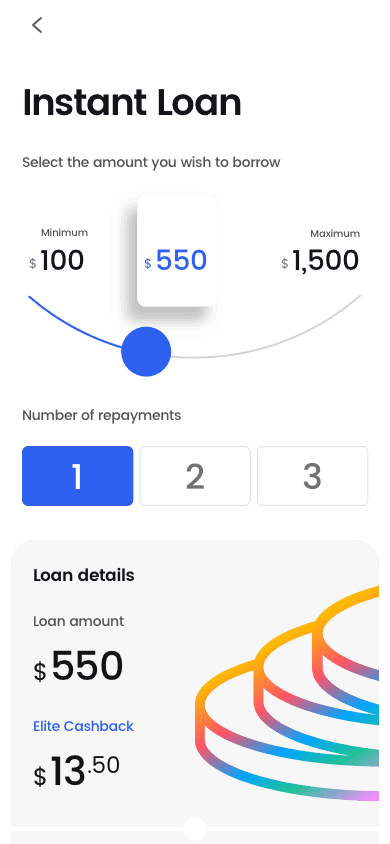
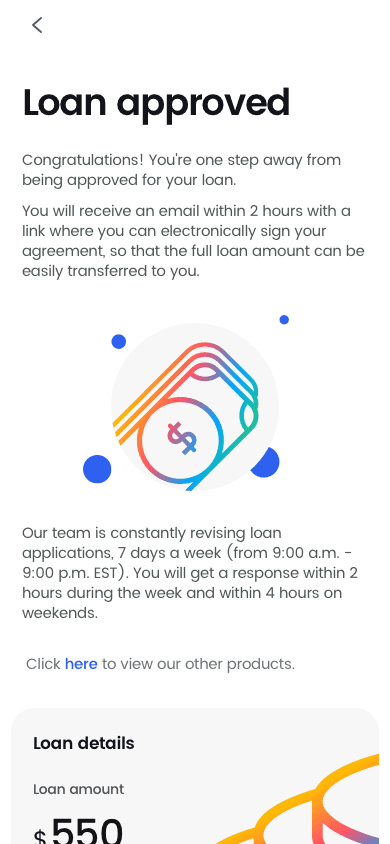
Our online loan application will tell you if you’re approved instantly. Once approved, all you have to do is electronically sign your contract. It’s that easy!
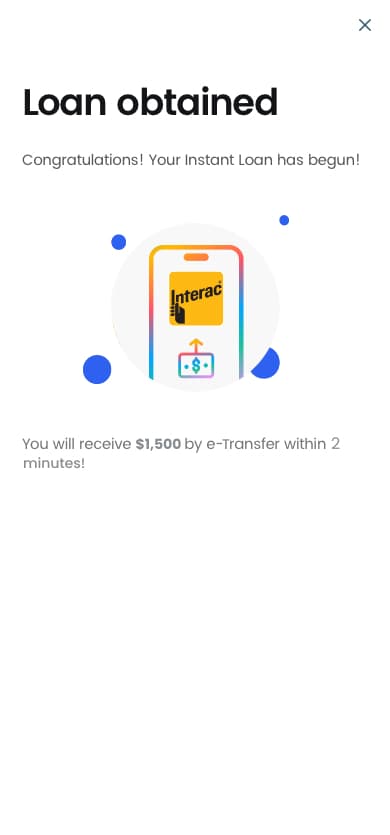
Once you sign your digital agreement, your cash advance will be sent by Interac e-Transfer® within 2 minutes. Fast, convenient and hassle-free. Funds are sent 24/7, no matter what.
The whole process is online from start to finish, and if you need help at any point, our support team is available 24/7.
Time is usually the reason Ontario residents choose a payday loan over a personal loan from a bank. The online application takes about five minutes, most applicants get a decision within minutes, and approved funds go out by Interac e-Transfer 24/7, including evenings and weekends. There's no branch appointment and no wait time while somebody reviews your file by hand.
Bad credit is more common than most residents realize, and the numbers show it clearly:
51,637 consumer insolvency filings were recorded in 2024, up 17.8% year over year and the largest increase of any province (CAIRP)
Ontario's average non-mortgage debt sits at $22,955, with Toronto residents carrying an average of $21,540 (Equifax)
How common is bad credit in Ontario? Bad credit is growing more common in Ontario: 51,637 consumer insolvency filings were recorded in 2024, up 17.8% year over year and the largest increase of any province. Ontario's rate was 4.4 per 1,000 adults, above the national average of 4.2. Loss of income remains the top cited cause, according to federal insolvency data.
Score Range | Rating | What It Means |
300–559 | Poor | Most banks decline outright. Personal and auto loans are usually only available through subprime lenders, often at 25%–35% APR, and a mortgage is essentially out of reach at most institutions |
560–659 | Fair | About 15% of Canadians fall below 650 (FICO, 2024). Approval is possible, but personal loans often run 18%–30% APR, and most lenders require at least 620–640 just to qualify for an insured mortgage |
660–724 | Good | This is where the average Canadian sits (679, Borrowell 2026). Standard rates on loans and credit cards, and enough to qualify for an uninsured mortgage with 20%+ down (680+ typically required) |
725–759 | Very Good | Meaningfully lower rates on personal and auto loans, and access to most premium credit cards |
760–900 | Excellent | The tier tied to the best available rates across mortgages, auto loans, and premium cards. Roughly 41% of Canadians fall in the 800+ range alone |
The provincial average of 686 and Toronto's 693 both sit in the Good range, while Hamilton's 658 falls just inside Fair. You can check your own score for free through Borrowell or Credit Karma, and both let you review your full report without affecting your score. Knowing where you sit helps you judge which lenders are worth an application. Unsure what a term means? Check our key terms glossary.
Bad credit loans cost exactly the same as any other payday loan we offer, because your score doesn't change the fee. Payday loan fees are capped by provincial regulation and charged as a flat rate, not as interest that compounds over time. Here's what the fees look like in practice:
You borrow | Fee at $14 per $100 | Total repayment |
$100 | $14 | $114 |
$500 | $70 | $570 |
$1,000 | $140 | $1,140 |
$1,500 | $210 | $1,710 |
In Ontario, you can only access a loan with one repayment, except if it is your third loan within 63 days. The maximum allowable cost of borrowing under the payday loan agreement is $14 for every $100 advanced.
On a $500 loan of 14 days, the total cost of borrowing is $70, with a total payback amount of $570 and an APR of 365%. On a loan of 62 days, the APR is 82.42%. The shorter the repayment period, the higher the APR, so choose a due date that fits your budget, and try our loan budgeting calculator before you apply.
The $14 per $100 fee reflects the full cost of borrowing at a flat rate, not a compounding rate that grows over time. Whatever amount you borrow, from $100 to $1,500, you will always know exactly how much money you'll repay and when, with no hidden charges added later. Payday loans are short-term products for genuine emergencies, so confirm you can repay on your due date and read our guides on borrowing responsibly and responsible lending.
For more information on your rights as a borrower, read payday loan: your rights or visit the Financial Consumer Agency of Canada (fcac-acfc.gc.ca).
Bad credit loans solve a short-term cash problem, but a few habits will help your score recover and get you back on solid financial footing over the longer term:
Pay every bill on time. Payment history is the single biggest factor in your credit score, and even one on-time payment a day before it's due builds the pattern lenders want to see.
Keep your credit card balances low. Using less than 30% of your available limit signals that you aren't stretched.
Check your credit report for errors. A free annual review through Equifax or TransUnion can catch accounts and debt that were never yours.
Tackle the most expensive debt first. Paying down the card with the highest interest rate frees up income faster than spreading payments evenly.
Space out applications. Each new application can leave a mark, so apply only when you need to.
Talk to a non-profit credit counsellor. Free help is available across Canada if monthly debt payments have become unmanageable. See our list of credit counsellors.


Behind each review is an experience that matters
Since 2016, we've helped over 1.6 millions Canadians get instant loans online.
Since 2016, we've helped over 1.6 millions Canadians get instant loans online.
Read more reviews.
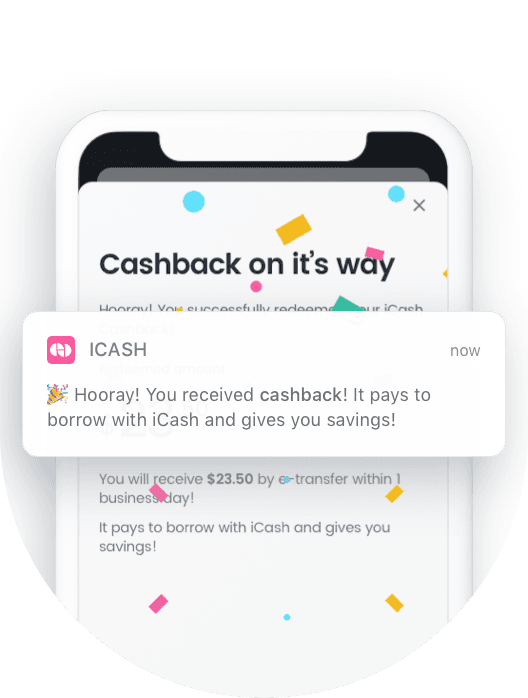
Earn money every time you borrow with iCash! Our unique cashback program is designed to reward you for being a loyal customer and can help you save on future loan payments. After successfully paying off your first online loan, you'll receive 4% of the cost of borrowing credited to your account. You can earn up to 12% depending on how many iCash loans you have repaid.
Have more questions? Check out our full FAQ.